Agentic AI Meets Social Media: How Autonomous Agents Are Changing Content Distribution
TL;DR
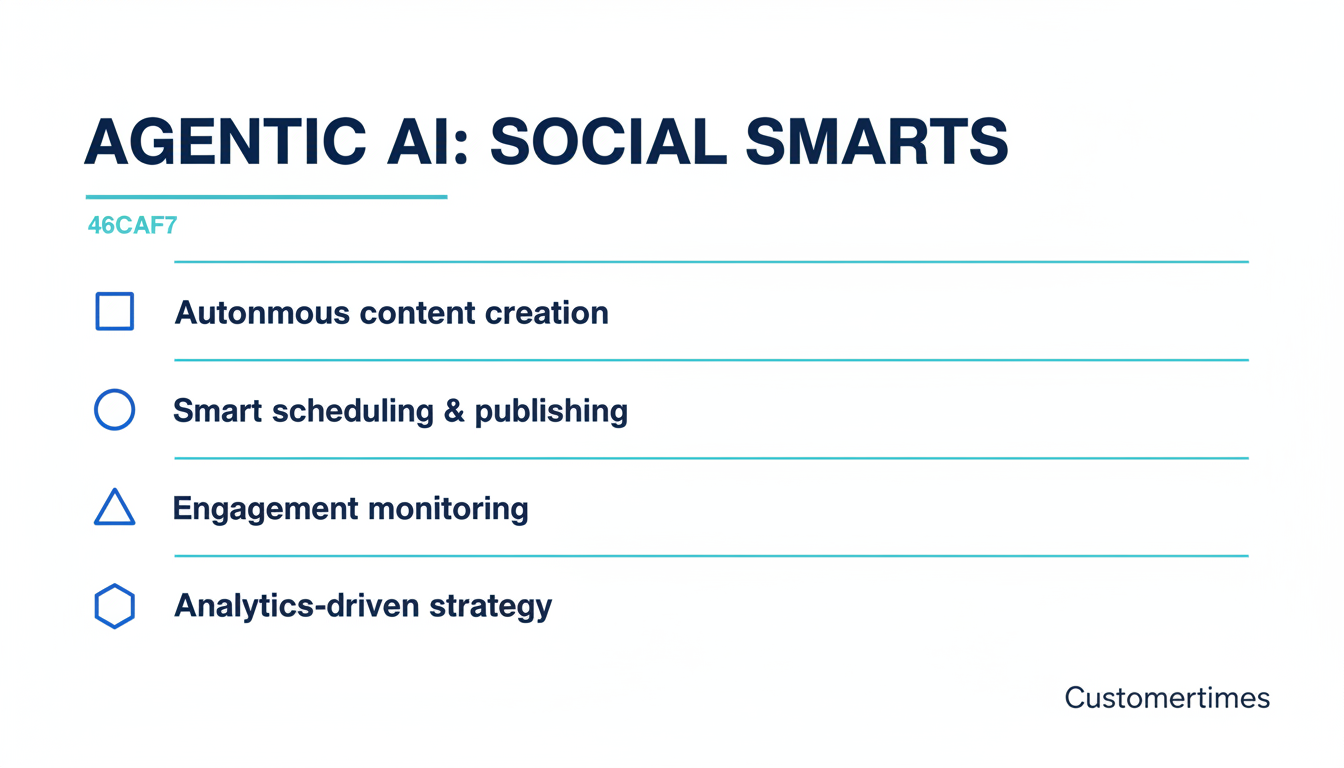
Explore how agentic AI is transforming social media management — from content creation to engagement to analytics. Learn the tech stack behind autonomous social media agents and how Publora serves as the API layer connecting AI to 10+ platforms.
The Rise of Agentic AI: From Chat Assistants to Autonomous Operators
Something fundamental shifted in AI during 2025. We moved past the era of chatbots that answer questions and into the era of AI agents that take action. The difference is not subtle. A chatbot writes you a social media caption when you ask. An agentic AI system monitors your analytics, identifies that engagement dropped on Thursdays, researches trending topics in your niche, drafts three post variants, selects the strongest one based on historical performance, schedules it across five platforms, and reports back with results — all from a single instruction like "improve our Thursday engagement."
This is not a hypothetical scenario. It is happening right now, across industries from software engineering to supply chain management to, yes, social media marketing. And it is changing how teams of every size think about content distribution.
What you'll learn in this article:
- What agentic AI actually means — beyond the buzzword
- How autonomous AI agents apply to social media management
- The technical architecture that makes it work (LLMs + MCP + APIs)
- Real-world workflows: from trend monitoring to cross-platform publishing
- Risks to take seriously: hallucinations, brand safety, authenticity
- What's coming next with multi-agent systems
What Is Agentic AI? A Clear Definition
The term "agentic AI" gets thrown around loosely, so let's define it precisely. An autonomous AI agent is a system that can:
Plan multi-step tasks
Break a high-level goal into concrete steps, decide the order, and execute them sequentially or in parallel.
Use external tools
Call APIs, query databases, read files, browse the web — interact with the real world, not just generate text.
Adapt based on feedback
Observe the results of its actions and adjust its approach. If a post underperforms, change the strategy for the next one.
Operate with minimal supervision
Execute complex workflows without requiring human input at every step. Report back when done or when a decision exceeds its authority.
This is different from a simple LLM chat interface in the same way that a self-driving car is different from GPS navigation. GPS tells you where to turn. A self-driving car actually turns the wheel.
Agentic AI Beyond Social Media
To understand the scope of this shift, consider how agentic AI is already operating across industries:
- Software engineering: Agents like Devin and Claude Code can read a GitHub issue, write the code to fix it, run tests, create a pull request, and iterate based on code review comments — autonomously completing tasks that once required a developer's full attention.
- Customer support: AI agents resolve tickets end-to-end by reading the customer's history, querying internal systems, applying the appropriate fix, and composing a response — escalating to humans only for edge cases.
- Research: Agents can take a research question, search academic databases, read papers, synthesize findings, and produce a structured report with citations — a task that previously took days of manual work.
- Supply chain: Agents monitor inventory levels, predict demand spikes from external signals, and automatically adjust purchase orders — reacting faster than any human procurement team.
Social media management is a natural fit for this paradigm because it involves repetitive, multi-step workflows that benefit from speed and consistency, but also require creative judgment that simple automation cannot provide.
From Assistive to Autonomous: The Three Waves of AI in Marketing
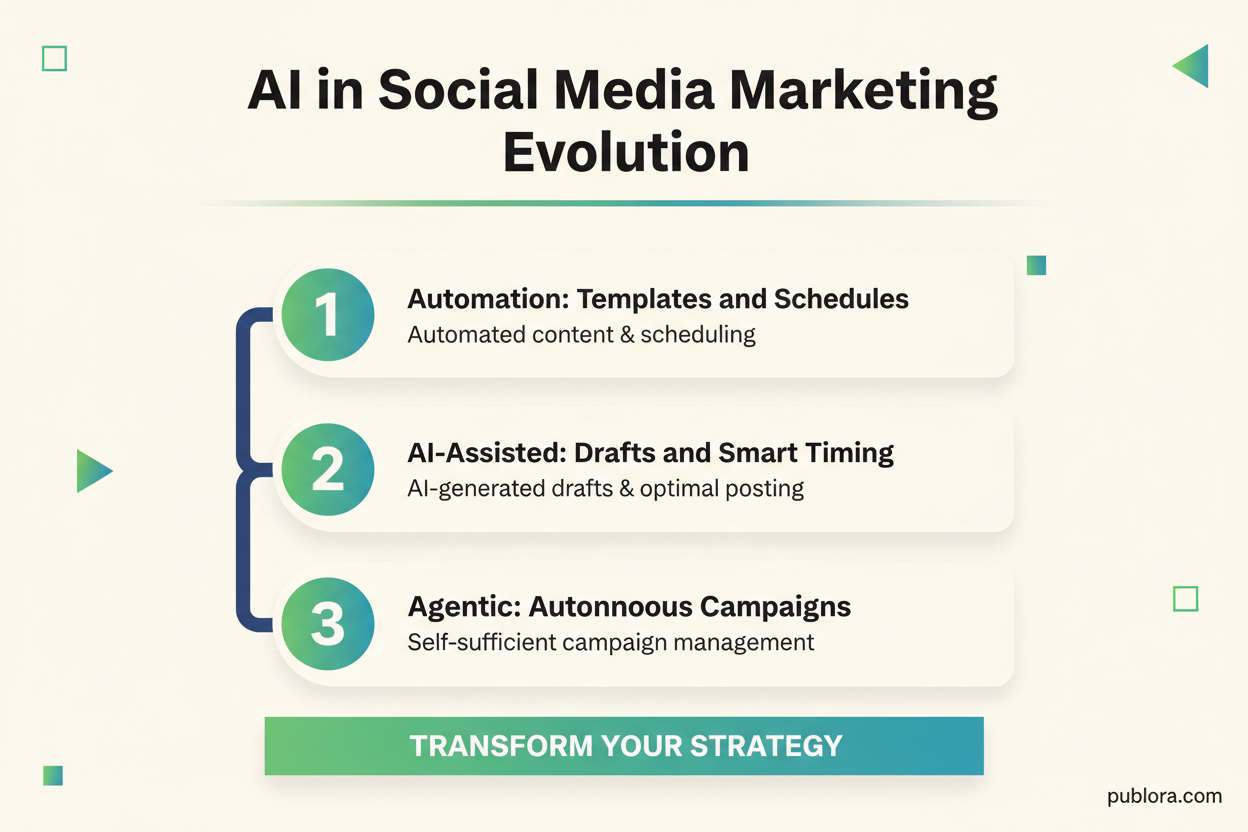
The evolution of AI in marketing has followed a clear trajectory. Understanding where we are helps clarify where we're going.
Wave 1
Automation
Rule-based scheduling, auto-replies, if/then workflows. Buffer, Hootsuite, Zapier. No intelligence — just predetermined actions.
Wave 2
AI-Assisted
LLMs generate captions, suggest hashtags, recommend posting times. Human still decides, reviews, and clicks "publish." ChatGPT era.
Wave 3
Agentic
AI agents plan, create, publish, analyze, and optimize autonomously. Human sets goals and guardrails. The agent executes the strategy.
Most marketing teams today are somewhere between Wave 2 and Wave 3. They use AI to draft content but still rely on humans for the scheduling, cross-posting, performance monitoring, and strategy adjustment. Agentic AI collapses those manual steps into a single automated pipeline.
How Agentic AI Applies to Social Media
Let's get specific. Here are the five areas where autonomous AI agents are transforming social media management — not in theory, but in practice.
1. Content Creation at Scale
An AI agent does not just write one caption when asked. It can produce an entire content calendar: analyzing your brand voice from past posts, studying competitor content, identifying gaps in your topic coverage, and generating a week's worth of posts across multiple formats (text, carousel copy, video scripts) — adapted for each platform's conventions.
The key difference from using ChatGPT manually: the agent remembers context. It knows what you posted last week, which topics performed well, and what your audience engages with. Each new piece of content is informed by everything that came before.
2. Intelligent Scheduling and Distribution
Traditional scheduling tools let you pick a time slot. An AI agent chooses the time slot based on analysis: when your specific audience is most active, what your competitors are posting at that hour, whether there's a trending topic that would boost visibility if you post now versus tomorrow.
Cross-platform distribution gets smarter too. Instead of posting the same content everywhere, an agent adapts the format: a detailed thread for X, a visual carousel for Instagram, a professional narrative for LinkedIn, and a concise message for Telegram — all from the same core idea.
3. Engagement Monitoring and Response
Agents can monitor comments, mentions, and DMs across platforms. For routine interactions (thank you messages, common questions, simple customer support queries), the agent handles them directly. For sensitive or complex conversations, it flags them for human review with a recommended response and context summary.
4. Performance Analytics and Optimization
This is where agentic AI diverges most sharply from traditional tools. Instead of generating a dashboard and waiting for a human to interpret it, an agent reads the analytics, identifies patterns, forms hypotheses about what's working and what isn't, and adjusts the strategy automatically. If video content outperforms static images on Wednesdays, the agent shifts Wednesday content to video — without being told.
5. Trend Detection and Real-Time Response
AI agents can continuously monitor news feeds, social trends, competitor activity, and industry developments. When a relevant trending topic emerges, the agent can draft a timely post, check it against brand guidelines, and queue it for publication — in minutes rather than the hours it takes a human team to notice, discuss, draft, approve, and post.
A Real-World Workflow: From Trend to Published Post
To make this concrete, here's what an end-to-end agentic workflow looks like for a marketing team:
Marketing Manager: Monitor AI industry news daily. When something relevant to our audience happens, draft a post with our take, schedule it across LinkedIn, X, and Telegram within 2 hours. Focus on practical implications, not hype. Keep our professional but approachable tone.
Here's what the agent does with that instruction:
Agent execution flow:
- Monitor — The agent scans configured news sources, RSS feeds, and social listening tools every 30 minutes for relevant stories.
- Evaluate — When a story about a major AI model release appears, the agent scores it for relevance to the brand's audience (tech founders, marketers, developers).
- Draft — The agent writes three variants: a LinkedIn article-style post (600 words), an X thread (5 tweets), and a Telegram message (200 words). Each matches the platform's conventions.
- Review against guidelines — The agent checks for factual accuracy against the source, scans for potential controversy, and ensures tone matches the brand voice document.
- Schedule via API — The agent calls Publora's create-post endpoint with platform-specific content, targeting the next optimal posting window for each platform.
- Report — The agent sends a summary to the marketing manager: "Scheduled 3 posts about [topic] across LinkedIn, X, and Telegram. Publishing at 10:15 AM, 10:30 AM, and 11:00 AM respectively. Draft previews attached."
After publication, the agent continues working. It monitors engagement for the next 48 hours, compares performance against baseline metrics, and logs insights that inform future content decisions. If the post performs exceptionally well, the agent might suggest repurposing it into a longer blog post or a carousel for Instagram.
The Tech Stack: How Autonomous Social Media Agents Work
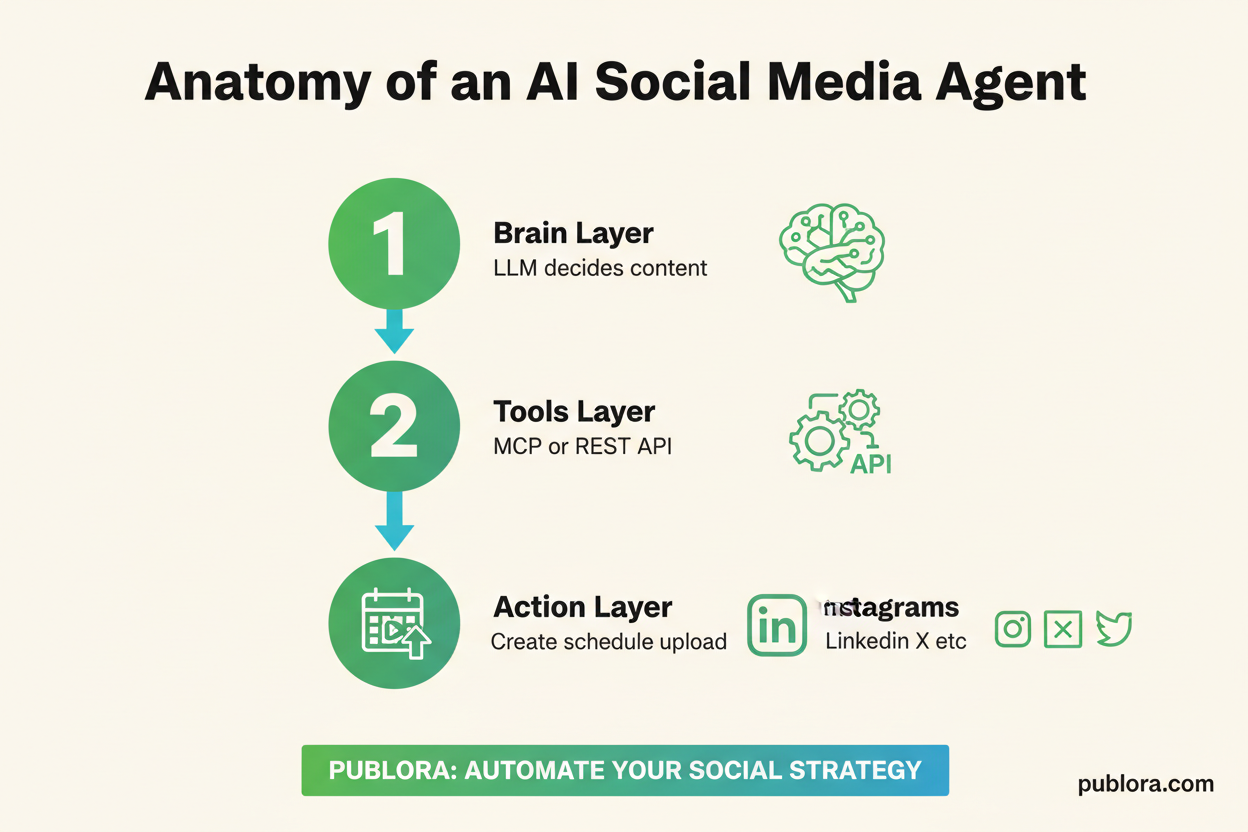
Understanding the architecture helps you evaluate what's possible today versus what's still aspirational. A functional AI agent for social media requires three layers:
Brain Layer
A large language model (Claude, GPT-4, Gemini) that reasons, plans, and generates content. This is the decision-making core.
Tool Layer
MCP servers and REST APIs that give the agent hands. Publora's MCP server provides 18 social media tools. Other MCP servers add analytics, CRM, email, and more.
Platform Layer
The actual social networks (Instagram, LinkedIn, X, Telegram, etc.) accessed through their official APIs. Publora abstracts this layer into a unified interface.
Why MCP Changes the Game
MCP (Model Context Protocol) is the connective tissue that makes agentic AI practical. Before MCP, connecting an AI model to an external service meant writing custom integration code for every tool. MCP standardizes this: any AI model that supports MCP can connect to any MCP-compatible server and immediately discover its capabilities.
For social media specifically, this means an AI agent can connect to Publora's MCP server and instantly gain the ability to:
- Create and schedule posts across 10 platforms
- Upload images and videos via presigned URLs
- List and manage platform connections
- Read post history and calendar
- Update or cancel scheduled posts
No custom code, no API wrapper library, no SDK to learn. The agent discovers the tools and uses them.
REST API for Autonomous Agents
For agents that run on a schedule without human interaction (a cron job, a background worker, a CI/CD pipeline), Publora's REST API is the better fit. It's simpler HTTP requests with a single API key — no session management, no MCP handshake.
import requests

# A fully autonomous agent posting to multiple platforms
API_KEY = "sk_YOUR_API_KEY"
BASE = "https://api.publora.com/api/v1"
headers = {"Content-Type": "application/json", "x-publora-key": API_KEY}

# Step 1: Agent has already generated content from trend analysis
content = {
    "linkedin": "We just saw Google release Gemini 3...",
    "x": "Thread: Google just dropped Gemini 3. Here's what it means for developers:\n\n1/5",
    "telegram": "Breaking: Gemini 3 is out. Key takeaway..."
}

# Step 2: Get available platforms
connections = requests.get(f"{BASE}/connections", headers=headers).json()

# Step 3: Create platform-specific posts
for platform_type, text in content.items():
    platform_id = next(
        c["id"] for c in connections["connections"]
        if c["platform"] == platform_type
    )
    resp = requests.post(f"{BASE}/create-post", headers=headers, json={
        "content": text,
        "platforms": [platform_id],
        "scheduledTime": "2026-04-08T10:00:00Z"
    })
    print(f"Scheduled on {platform_type}: {resp.json()['postGroupId']}")
MCP vs. REST API: When to use which
MCP is ideal for interactive AI assistants (Claude Code, Cursor, Windsurf) where a human is in the loop. REST API is better for fully autonomous agents running on a schedule. Both provide the same capabilities. See the client setup guide for detailed comparison.
Publora as the Social Media Layer for AI Agents
If an AI agent is the brain, it needs hands to interact with social platforms. This is exactly what Publora provides: a unified API layer that connects AI agents to 10 social networks through both MCP and REST interfaces.
The architecture is intentionally simple:
Your AI Agent
Claude, GPT, custom agent
MCP / REST
Standard protocols
Publora
Unified social media API
Platform APIs
Meta, LinkedIn, X, etc.
Social Networks
Your audience sees the posts
What makes this particularly useful for agentic AI:
- One integration, 10 platforms. Your agent doesn't need separate OAuth flows, different payload formats, or platform-specific error handling for each network. Publora normalizes everything into a single create-post endpoint.
- Scheduling as a safety net. Posts are queued, not published instantly. This gives humans a review window before content goes live — essential for responsible agentic AI deployment.
- Media handling included. Upload images and videos via presigned URLs. The agent doesn't need to manage S3 buckets or worry about format conversion.
- MCP for discovery. When connected via MCP, the agent automatically discovers all 18 available tools — no documentation reading required. The agent can introspect what's possible and use the right tool for each task.
Connecting an AI Agent to Publora
For an interactive AI assistant (Claude Code, Cursor, Windsurf), add Publora as an MCP server:
{
  "mcpServers": {
    "publora": {
      "type": "http",
      "url": "https://mcp.publora.com",
      "headers": {
        "Authorization": "Bearer sk_YOUR_API_KEY"
      }
    }
  }
}
For a fully autonomous agent running in the background, use the REST API with a single API key header. The authentication docs cover key generation and permission scoping.
Risks and Considerations: What Can Go Wrong
The enthusiasm around agentic AI is warranted, but responsible deployment requires acknowledging the risks. These are not theoretical — they are failure modes teams encounter today.
Hallucinations
LLMs sometimes generate plausible-sounding but factually incorrect statements. In social media, this means your brand could publish false statistics, misattribute quotes, or make claims about products that aren't true. Mitigation: Require source verification for factual claims. Use a secondary model to fact-check before publishing. Keep humans in the loop for content that includes data points or quotes.
Brand Safety
An agent that posts autonomously could publish content that contradicts your brand values, takes a stance on a political issue, or responds to a controversy in a tone-deaf way. Mitigation: Define explicit content policies. Implement keyword and topic filters. Use Publora's scheduling to create a review buffer. Restrict autonomous posting to low-risk content categories initially.
Authenticity Erosion
Audiences can often detect AI-generated content, and excessive automation can make a brand feel impersonal. Mitigation: Use AI for drafting and distribution, but inject genuine human perspectives. Share real experiences, opinions, and behind-the-scenes content that AI cannot fabricate. Disclose AI involvement where appropriate.
Runaway Agents
A misconfigured agent could post hundreds of times, engage inappropriately with users, or spend budget on promoted posts without authorization. Mitigation: Set hard rate limits. Use Publora's API rate limiting as a backstop. Implement daily post caps. Require approval for any financial actions (boosting, ads).
Do
- Start with human-in-the-loop — review posts before they publish
- Define clear content policies the agent must follow
- Use scheduling buffers (schedule 2+ hours ahead, never instantly)
- Set daily post limits per platform
- Log every agent action for audit trails
- Test with low-stakes content before expanding scope
Don't
- Give an agent unrestricted publishing access from day one
- Let agents post about sensitive topics without human review
- Assume the AI will never make mistakes with facts
- Automate crisis communications — humans must lead
- Ignore platform ToS — automated posting has rules
- Skip disclosure where regulations require it
The golden rule of agentic social media
Automate the execution, not the judgment. Let agents handle scheduling, formatting, cross-posting, and performance tracking. Keep humans responsible for strategy, brand voice, crisis response, and any content that touches sensitive topics. The goal is not to remove humans from social media — it's to remove the tedious 80% so humans can focus on the high-impact 20%.
What's Coming Next: Multi-Agent Systems and Autonomous Social Presence
The current generation of agentic AI — a single agent connected to tools — is just the beginning. Here's what the next 12-18 months are likely to bring.
Multi-Agent Collaboration
Instead of one agent doing everything, specialized agents will work together. A research agent monitors trends and competitive intelligence. A content agent generates posts based on research findings. An analytics agent evaluates performance and feeds insights back to the research agent. A community agent handles engagement and audience interaction. Each agent is optimized for its specific role, and they coordinate through shared context.
This mirrors how human marketing teams already work — different specialists collaborating — but at machine speed and with perfect information sharing.
Persistent Social Memory
Current agents lose context between sessions. Future agents will maintain a persistent understanding of your audience: which topics resonate with which segments, what tone works on which platform, what time of year certain themes perform best. This memory will compound over time, making the agent more effective the longer it runs.
Real-Time Adaptive Content
Agents will increasingly react in real time. If a post starts going viral, the agent could immediately create follow-up content to capitalize on the momentum. If engagement drops mid-campaign, the agent adjusts messaging on the fly. This kind of responsiveness is impractical for human teams but natural for always-on agents.
Cross-Channel Orchestration
The line between social media, email marketing, blog content, and paid advertising will blur. An agent that manages your social presence will coordinate with agents managing your newsletter, blog, and ad campaigns — ensuring consistent messaging and optimal sequencing across every customer touchpoint.
A reasonable timeline:
| Timeframe | Capability | Human Role |
|---|---|---|
| Now (2026) | Single agent drafts, schedules, and cross-posts. Basic performance analysis. | Reviews all content. Sets strategy. Handles engagement. |
| 2027 | Multi-agent teams. Persistent memory. Adaptive scheduling. Autonomous engagement for routine interactions. | Reviews flagged content. Defines brand voice. Manages crises. |
| 2028+ | Cross-channel orchestration. Predictive content strategy. Real-time campaign optimization. | Sets business objectives. Provides creative direction. Strategic decision-making. |
Getting Started with Agentic Social Media Today
You do not need to wait for multi-agent orchestration to start benefiting from agentic AI in your social media workflow. Here's how to begin with what's available right now:
- Connect your social accounts to Publora — Link your Instagram, LinkedIn, X, Telegram, and other platforms via OAuth. This is the foundation.
- Get your API key — In the Publora dashboard, go to Settings and create an API key. See the authentication guide.
- Choose your integration method — Use MCP for interactive AI assistants or the REST API for autonomous agents.
- Start small — Begin with agent-drafted content that you review before publishing. Use scheduling to create a review buffer.
- Expand gradually — As you build confidence in the agent's output quality, give it more autonomy: auto-scheduling, cross-platform adaptation, engagement responses.
Build your first AI-powered social workflow
Publora's MCP server and REST API give AI agents the ability to publish across 10 social networks. Start with a free account.
Get Started FreeFrequently Asked Questions
What is agentic AI and how is it different from regular AI?
Agentic AI refers to AI systems that can autonomously plan, execute, and adapt multi-step tasks without continuous human input. Unlike traditional AI assistants that respond to one prompt at a time, agentic AI maintains goals across sessions, uses tools (APIs, databases, web browsers), and makes decisions about what to do next. In social media, this means an AI agent can monitor trends, draft posts, schedule them across platforms, analyze performance, and adjust strategy — all without a human clicking buttons at each step.
Can an AI agent fully manage a brand's social media presence?
Technically yes, but practically it is not advisable yet. AI agents can handle content drafting, scheduling, cross-posting, and analytics autonomously. However, brand voice nuance, crisis response, and community relationship-building still benefit from human oversight. The recommended approach is a human-in-the-loop model where the agent does 80-90% of the execution work while a human reviews high-stakes content and sets strategic direction.
What is MCP and why does it matter for AI agents?
MCP (Model Context Protocol) is an open standard that lets AI models connect to external tools and services through a unified interface. Instead of writing custom API integrations for every service, an AI agent with MCP support can discover and use any MCP-compatible tool automatically. For social media, this means an agent can connect to Publora's MCP server and immediately gain the ability to create posts, upload media, manage schedules, and read analytics — without any custom code.
How do agentic AI systems avoid posting harmful or incorrect content?
Responsible agentic AI implementations use multiple safeguards: content policy filters that check posts before publishing, approval queues for sensitive topics, hallucination detection that flags unverified claims, rate limiting to prevent runaway posting, and audit logs that track every action. Platforms like Publora add a scheduling buffer — posts are queued rather than published instantly, giving humans time to review before content goes live.
What platforms can an AI agent post to through Publora?
Publora supports cross-platform posting to 10 social networks: Instagram, LinkedIn, X (Twitter), Threads, Telegram, Facebook, TikTok, YouTube, Mastodon, and Bluesky. An AI agent can publish to all of them simultaneously from a single API call, with platform-specific formatting handled automatically. See the platform documentation for each network's specific capabilities and limits.
Do I need to write code to use an AI agent for social media?
Not necessarily. If you use an MCP-compatible AI assistant like Claude Code, Cursor, or Windsurf, you can connect to Publora's MCP server with just a configuration file — no code required. The AI handles the API calls conversationally. For fully autonomous agents that run on a schedule without human interaction, you will need some code to set up the agent loop, but the social media operations themselves are handled entirely by the API.
What's the difference between an AI assistant and an AI agent?
An AI assistant responds to individual prompts — you ask a question, it answers. An AI agent pursues goals across multiple steps autonomously. An assistant might write a social media caption when asked. An agent monitors your analytics, identifies that engagement dropped on Tuesdays, researches trending topics for next Tuesday, drafts three post variants, picks the best one based on historical performance, schedules it, and reports back — all from a single high-level instruction like "improve our Tuesday engagement."
Is agentic AI for social media only for large enterprises?
No. Agentic AI is arguably more valuable for small teams and solo creators who lack dedicated social media staff. A solo founder managing five social channels can use an AI agent to maintain consistent posting across all platforms, respond to engagement patterns, and optimize timing — work that would otherwise require a part-time hire. Tools like Publora's API are priced for startups and individuals, not just enterprise budgets.
Further Reading
- Publora MCP Overview — How AI agents connect to Publora via Model Context Protocol
- MCP Client Setup Guide — Configure Claude Code, Cursor, Windsurf, and other MCP clients
- REST API Reference — Complete endpoint documentation for autonomous agents
- Authentication Guide — API key creation and permission scoping
- Rate Limits and Best Practices — Platform-specific posting limits
- How to Automate Instagram Posting with OpenClaw — Step-by-step tutorial with code examples
Related Articles
How Agencies Save $2,000/Year on Their Social Media Stack
The real math behind an agency switching its social stack: per-account vs per-seat pricing, a worked example, and how to calculate your own savings.
The Real Cost of "Free" Social Media Tools (2026)
"Free" social media tools come in two flavors - genuinely free-forever and trials in disguise. Here is what each really costs you, and what to look for in 2026.

Best Time to Post on LinkedIn in 2026: Data-Driven Guide
Data-driven analysis of optimal LinkedIn posting times by day and hour. Engagement patterns, B2B vs B2C differences, timezone strategies, and auto-scheduling with Publora analytics API.

How to Build an AI-Powered Social Media Calendar
Build an AI-driven content calendar with content pillars, optimal posting frequency, and automated scheduling via Publora API. Includes Python script for generating weekly calendars.