Best Time to Post on Social Media in 2026 (Data-Backed Guide)
TL;DR
Discover the best times to post on Instagram, LinkedIn, TikTok, Facebook, X, Threads, Pinterest, and YouTube in 2026. Based on engagement data from millions of posts.
TL;DR
The best time to post on social media in 2026 depends on the platform: Instagram peaks Tuesday–Wednesday 11 AM–1 PM, LinkedIn performs best Tuesday–Thursday 8–10 AM, TikTok spikes Tuesday and Thursday 2–5 PM, and Facebook hits peak engagement Wednesday–Thursday 9–11 AM. All times are in your audience's timezone. This guide breaks down optimal posting windows for 8 platforms with heatmaps and actionable scheduling tips.
8
Platforms covered
20–40%
Engagement boost from optimal timing
Tue–Thu
Universal best days across platforms
Why Posting Time Matters More Than You Think
Social media algorithms don't show your post to all your followers. They show it to a small group first — and if that group engages quickly, the algorithm pushes it to more people.
This means the first 30–60 minutes after posting are critical. If you publish when your audience is offline, your post gets low initial engagement, and the algorithm buries it. Post when they're actively scrolling, and you get a compounding visibility boost.
Research from Sprout Social, Buffer, and Hootsuite consistently shows that posts published during peak engagement windows receive 20–40% more interactions than those published at random times. For brands and creators posting daily, that difference compounds into thousands of extra impressions per month.
The key insight: Optimal timing isn't about when you want to post — it's about when your audience is most likely to see, react, and share. Every platform has a different rhythm because every platform serves a different context in people's daily routines.
Quick Cheat Sheet: Best Times by Platform
Here's the at-a-glance summary. Bookmark this, print it, or screenshot it — these are the data-backed optimal windows for each major platform in 2026.
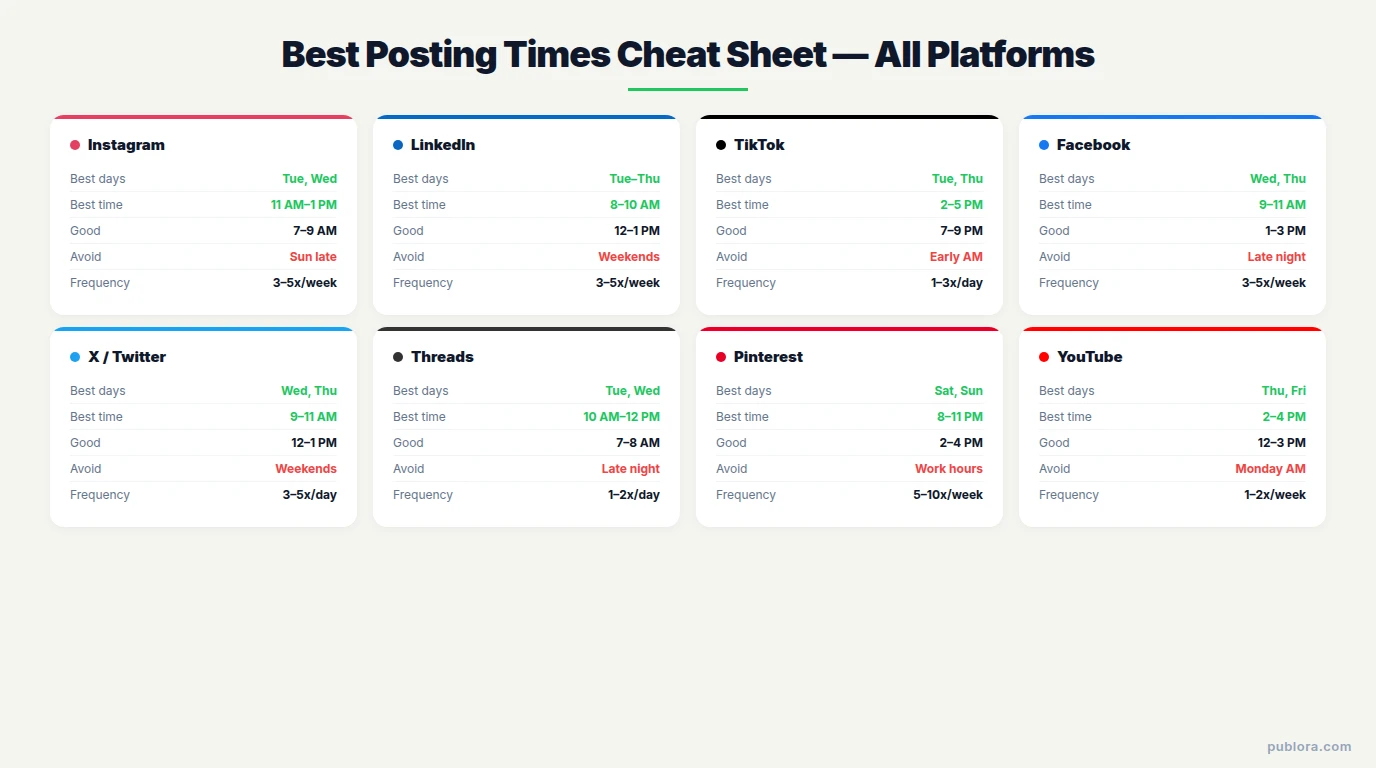
| Platform | Best Days | Best Time | Worst Time | Frequency |
|---|---|---|---|---|
| Tue, Wed | 11 AM–1 PM | Sun late night | 3–5x/week | |
| Tue–Thu | 8–10 AM | Weekends | 3–5x/week | |
| TikTok | Tue, Thu | 2–5 PM | Early AM | 1–3x/day |
| Wed, Thu | 9–11 AM | Late night | 3–5x/week | |
| X / Twitter | Wed, Thu | 9–11 AM | Weekends | 3–5x/day |
| Threads | Tue, Wed | 10 AM–12 PM | Late night | 1–2x/day |
| Sat, Sun | 8–11 PM | Work hours | 5–10x/week | |
| YouTube | Thu, Fri | 2–4 PM | Monday AM | 1–2x/week |
Best Time to Post on Instagram in 2026
Instagram remains the most competitive platform for visual content creators. With over 2 billion monthly active users and an algorithm that heavily favors early engagement, timing your posts correctly can make or break your reach.
Peak engagement window: Tuesday and Wednesday between 11 AM and 1 PM in your audience's timezone. This is the lunch-break scroll window — people check Instagram during their midday break, making it the highest-engagement slot.
Secondary window: Weekday mornings 7–9 AM (the commute check) and early evenings 5–7 PM (the after-work scroll).
Best for Feed Posts
- Tuesday, Wednesday 11 AM–1 PM
- Thursday 11 AM–12 PM
- Monday, Friday 7–9 AM
Best for Reels
- Monday–Thursday 9 AM–12 PM
- Friday 11 AM–1 PM
- Evening 7–9 PM (entertainment hours)
What to avoid: Sunday evenings after 8 PM show the lowest engagement rates. Late-night posting (after 11 PM) also performs poorly unless your audience is in a different timezone.
Posting frequency: 3–5 feed posts per week plus daily Stories. Quality over quantity — the algorithm penalizes accounts that post low-engagement content frequently.
Best Time to Post on LinkedIn in 2026
LinkedIn is a professional network with predictable usage patterns — people check it during work hours, primarily on desktop. This makes LinkedIn one of the most timing-sensitive platforms.
Peak engagement window: Tuesday through Thursday, 8–10 AM. Wednesday at 9 AM is consistently the single best time across all LinkedIn studies. This catches professionals during their morning routine before the workday gets busy.
Secondary window: Tuesday–Thursday 12–1 PM (lunch break check).
LinkedIn scheduling tip
LinkedIn's algorithm gives extra visibility to posts that generate comments in the first 60 minutes. Schedule your post for 8–9 AM and immediately engage with early commenters — this can 2–3x your reach. Tools like Publora let you schedule the post and set a reminder to engage when it goes live.
What to avoid: Weekends and evenings (after 6 PM). LinkedIn activity drops 70–80% on Saturday and Sunday. Friday afternoons also underperform as people mentally check out for the weekend.
Posting frequency: 3–5 posts per week. LinkedIn explicitly recommends this range. Going above daily posting can reduce average engagement per post.
For a detailed walkthrough on scheduling LinkedIn posts specifically, see our complete LinkedIn scheduling guide.
Best Time to Post on TikTok in 2026
TikTok's algorithm works differently from other platforms. Content can go viral days or weeks after posting, which makes timing less critical than on Instagram or LinkedIn — but it still matters for initial distribution.
Peak engagement window: Tuesday and Thursday, 2–5 PM. This is when the after-school and after-work crowd hits the app. TikTok usage skews younger (16–34), so the peak is later in the day than professional platforms.
Secondary window: Friday–Saturday 7–9 PM (entertainment prime time). Weekend evenings are strong for TikTok because the platform is primarily used for entertainment.
TikTok timing caveat
TikTok's For You Page algorithm is less time-dependent than feed-based platforms. A great TikTok can surface 48–72 hours after posting. Focus on content quality first, timing second. That said, posting during peak hours gives your video the best shot at that critical initial push.
What to avoid: Early morning (before 9 AM) — TikTok users are night owls and afternoon scrollers, not early risers.
Posting frequency: 1–3 times per day. TikTok rewards consistent, high-volume posting more than any other platform. Many successful creators post 2–3 times daily.
Best Time to Post on Facebook in 2026
Facebook's organic reach has declined significantly, but timing still influences the engagement you do get. The platform's user base skews older (25–55), which affects when they're active.
Peak engagement window: Wednesday and Thursday, 9–11 AM. Mid-morning during the work week — people check Facebook during work breaks, especially mid-week when the novelty of the work week has worn off.
Secondary window: Tuesday–Thursday 1–3 PM. The post-lunch scroll is reliable but not as strong as the morning peak.
What to avoid: Late night (after 10 PM) and very early morning. Facebook engagement drops to near-zero between midnight and 6 AM. Weekend mornings also underperform.
Posting frequency: 3–5 times per week for pages. Posting more than once per day can dilute your reach as Facebook's algorithm limits how often one page appears in a user's feed.
Best Time to Post on X (Twitter) in 2026
X is a real-time platform where content has the shortest lifespan. A tweet's peak engagement happens in the first 15–30 minutes — after that, it's buried by the firehose of new content. Timing matters enormously here.
Peak engagement window: Wednesday and Thursday, 9–11 AM. Business professionals and news consumers check X during the morning work window. This is when discussions and threads get the most traction.
Secondary window: Weekdays 12–1 PM (lunch break). Breaking news and trending topics also create unpredictable spikes throughout the day.
What to avoid: Weekends — unless you're in news, sports, or entertainment. Professional/B2B X content drops 50–60% on Saturday and Sunday.
Posting frequency: 3–5 times per day. X's fast-moving feed means you need higher volume to stay visible. Threads and replies count toward engagement and visibility.
Best Time to Post on Threads in 2026
Threads (by Meta) is still maturing as a platform, and engagement data is less established than older platforms. However, early patterns show it follows Instagram's rhythms closely, with some key differences.
Peak engagement window: Tuesday and Wednesday, 10 AM–12 PM. Threads users tend to be Instagram power users who check both apps during similar windows.
Secondary window: Weekday mornings 7–8 AM. The early adopter crowd on Threads tends to be more digitally engaged and checks in during the morning commute.
What to avoid: Late night posting. Threads hasn't developed the late-night scrolling culture that TikTok and X have.
Posting frequency: 1–2 times per day. Threads rewards conversation starters — posts that spark replies perform significantly better than broadcast-style content.
Best Time to Post on Pinterest in 2026
Pinterest is fundamentally different from other social platforms. It's a visual search engine, not a social feed. Pins have an incredibly long lifespan — a well-optimized pin can drive traffic for months or years. Timing is less about immediate engagement and more about seeding the algorithm.
Peak engagement window: Saturday and Sunday, 8–11 PM. Pinterest usage spikes on weekend evenings when people are planning — planning meals, outfits, home projects, travel, and events.
Secondary window: Weekday afternoons 2–4 PM, particularly Friday (weekend planning starts early).
What to avoid: Weekday work hours (9 AM–5 PM). Unlike LinkedIn and X, Pinterest usage drops during the traditional workday because it's associated with personal planning, not professional tasks.
Posting frequency: 5–10 pins per week. Consistency matters more than volume. Spread pins throughout the week rather than batch-publishing all at once.
Best Time to Post on YouTube in 2026
YouTube operates on a different timescale than other platforms. Videos accumulate views over days and weeks, not hours. Publishing time matters less for long-term performance but affects initial velocity, which influences algorithmic recommendations.
Peak publishing window: Thursday and Friday, 2–4 PM. Publishing in the early afternoon gives YouTube time to process and index your video before the evening viewing peak (7–10 PM). Weekend videos also perform well because people have more leisure time to watch.
Secondary window: Wednesday 12–3 PM. Mid-week publishing catches the Thursday–Sunday viewing cycle.
YouTube timing nuance
YouTube recommends publishing 2–3 hours before your audience's peak viewing time. This gives YouTube's algorithm time to process, index, and begin recommending your video. If your viewers watch most at 7 PM, publish at 4–5 PM.
What to avoid: Monday mornings — people are returning to work and not in "YouTube mode." Late-night publishing (after 11 PM) also reduces initial views because there's less audience awake to seed the algorithm.
Posting frequency: 1–2 videos per week. YouTube values watch time and session time more than post frequency. One excellent video per week beats three mediocre ones.
Visual Heatmaps: Engagement Patterns by Platform
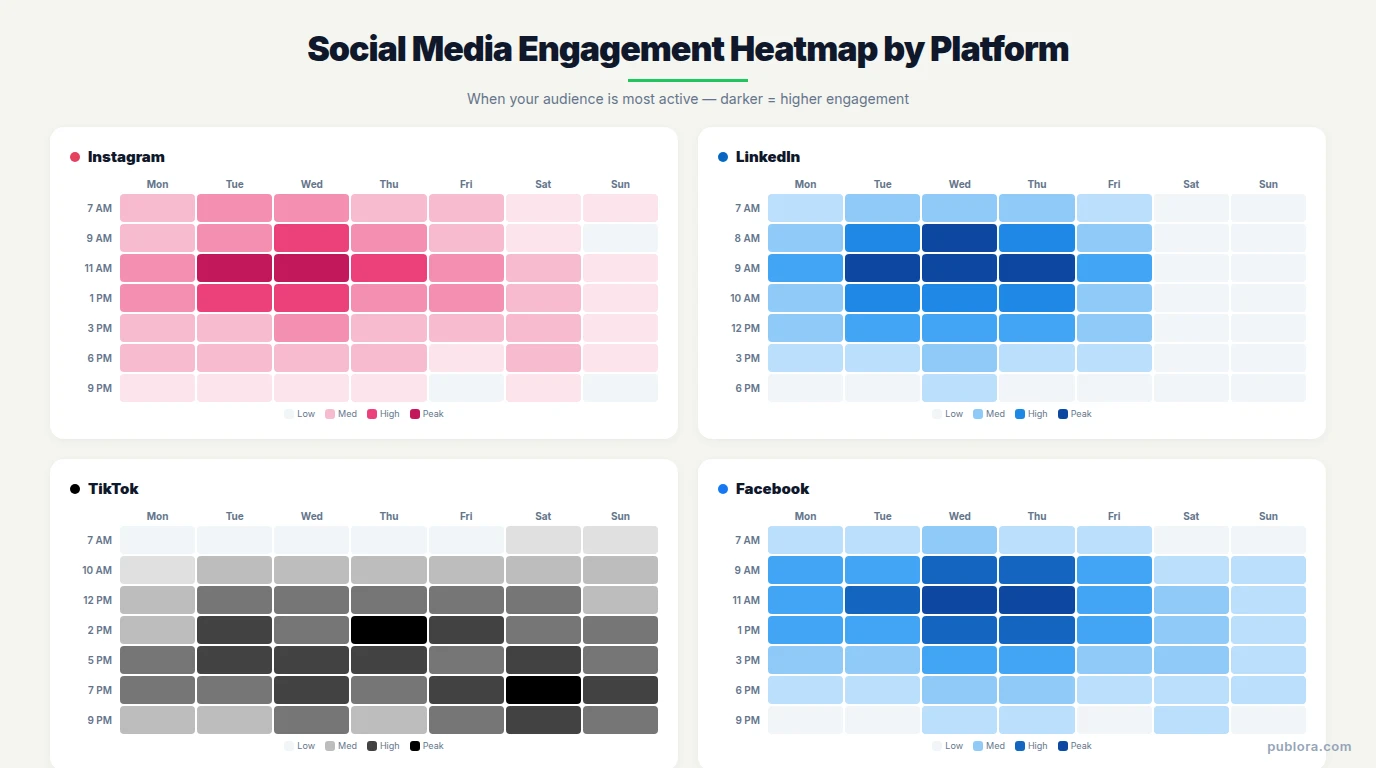
The following heatmaps show weekly engagement patterns across four major platforms. Darker colors indicate higher engagement — use these to plan your weekly content schedule.
3 Universal Patterns Across All Platforms
While each platform has its own optimal window, three patterns hold true everywhere:
1. Mid-week outperforms Monday and Friday
Tuesday through Thursday consistently shows higher engagement across all platforms. Monday has a "warm-up" effect (people are catching up after the weekend), and Friday engagement drops as people mentally disengage from screens.
2. Morning peaks exist everywhere
Whether it's 8 AM for LinkedIn or 11 AM for Instagram, every platform has a morning engagement spike. This reflects the universal habit of checking social media during the first half of the day. The specific time varies based on the platform's audience demographics.
3. Your audience is unique
These are averages based on millions of accounts. Your specific audience may behave differently. A fitness creator's audience might be most active at 6 AM. A gaming creator's audience peaks at 9 PM. Use these benchmarks as starting points, then test and refine based on your own analytics.
How to Find YOUR Best Posting Time
Generic data is a starting point — not the finish line. Here's how to discover the optimal posting times for your specific audience:
Step 1: Check your native analytics
Instagram Insights, LinkedIn Analytics, TikTok Analytics, and Facebook Page Insights all show when your followers are most active. This data is specific to your audience and overrides any general recommendation.
Step 2: Run a 2-week timing experiment
Post similar content at different times over two weeks. Keep the content quality and format consistent — only change the time. Track engagement rate (not just likes — comments, shares, saves, and clicks) for each time slot.
Step 3: Use a scheduling tool with analytics
Tools like Publora include analytics dashboards that show your engagement by day and time. Schedule posts across different time slots and let the data tell you what works. Some tools even offer best-time suggestions based on your historical performance.
Step 4: Revisit quarterly
Audience behavior shifts with seasons, algorithm changes, and platform updates. Re-run your timing analysis every 2–3 months to stay optimal. What worked in January may not work in July — summer schedules, holiday periods, and major events all shift engagement patterns.
How to Schedule Posts at the Right Time
Knowing the best time to post is only half the equation. You also need a reliable way to schedule content in advance. Here are your options:
Publora (Recommended)
From $2.99/mo — 10 platforms, AI editor, MCP support
- Schedule to Instagram, LinkedIn, TikTok, X, Facebook, Threads, Pinterest, YouTube, Bluesky, Mastodon
- Visual content calendar
- Bulk scheduling
- Free plan available
Other Options
Native schedulers + alternatives
- Platform native schedulers (free, limited)
- Buffer (from $6/channel/mo)
- Hootsuite (from $99/mo)
- Later, Publer, Sprout Social
For a detailed comparison of all scheduling tools, see our Best Social Media Scheduling Tools 2026 roundup.
Frequently Asked Questions
What is the best time to post on social media in 2026?
The universal best time across most platforms is Tuesday through Thursday between 9–11 AM in your audience's timezone. However, each platform has its own optimal window: Instagram peaks at 11 AM–1 PM, LinkedIn at 8–10 AM, TikTok at 2–5 PM, and Facebook at 9–11 AM.
Does posting time actually affect engagement?
Yes. Studies show that posting at optimal times can increase engagement by 20–40% compared to posting at random times. Timing determines how many people see your post in the critical first hour, which affects how the algorithm distributes it to a wider audience.
Should I post at the same time on every platform?
No. Each platform has a different audience and usage pattern. LinkedIn users are active during business hours, TikTok users peak in the afternoon and evening, and Pinterest users are most active on weekends. Use a scheduling tool like Publora to set different times for each platform.
What timezone should I use for scheduling posts?
Always schedule in your audience's timezone, not yours. If most of your followers are in the US, use Eastern Time. If they're in Europe, use CET. Most scheduling tools including Publora handle timezone conversion automatically.
How often should I post on social media?
Optimal frequency varies by platform: Instagram 3–5x/week, LinkedIn 3–5x/week, TikTok 1–3x/day, X/Twitter 3–5x/day, Facebook 3–5x/week, Threads 1–2x/day, Pinterest 5–10x/week, YouTube 1–2x/week. Consistency matters more than volume.
What is the worst time to post on social media?
Generally, late night (after 10 PM) and very early morning (before 6 AM) see the lowest engagement across all platforms. For professional platforms like LinkedIn, weekends are also poor. The exception is TikTok and Pinterest, where evening and weekend activity can be strong.
Schedule posts at the perfect time — automatically
Publora supports 10 platforms with a visual calendar, bulk scheduling, and AI editor. Free plan available.
Start Scheduling FreeFurther Reading
- Best Social Media Scheduling Tools 2026 — Full comparison of 12 tools
- How to Schedule LinkedIn Posts — Step-by-step guide with tool comparison
- Why Thousands Are Leaving Hootsuite — Hootsuite alternatives breakdown
- Connect Publora MCP to Claude Code — Schedule from your terminal
Related Articles
How Agencies Save $2,000/Year on Their Social Media Stack
The real math behind an agency switching its social stack: per-account vs per-seat pricing, a worked example, and how to calculate your own savings.
The Real Cost of "Free" Social Media Tools (2026)
"Free" social media tools come in two flavors - genuinely free-forever and trials in disguise. Here is what each really costs you, and what to look for in 2026.
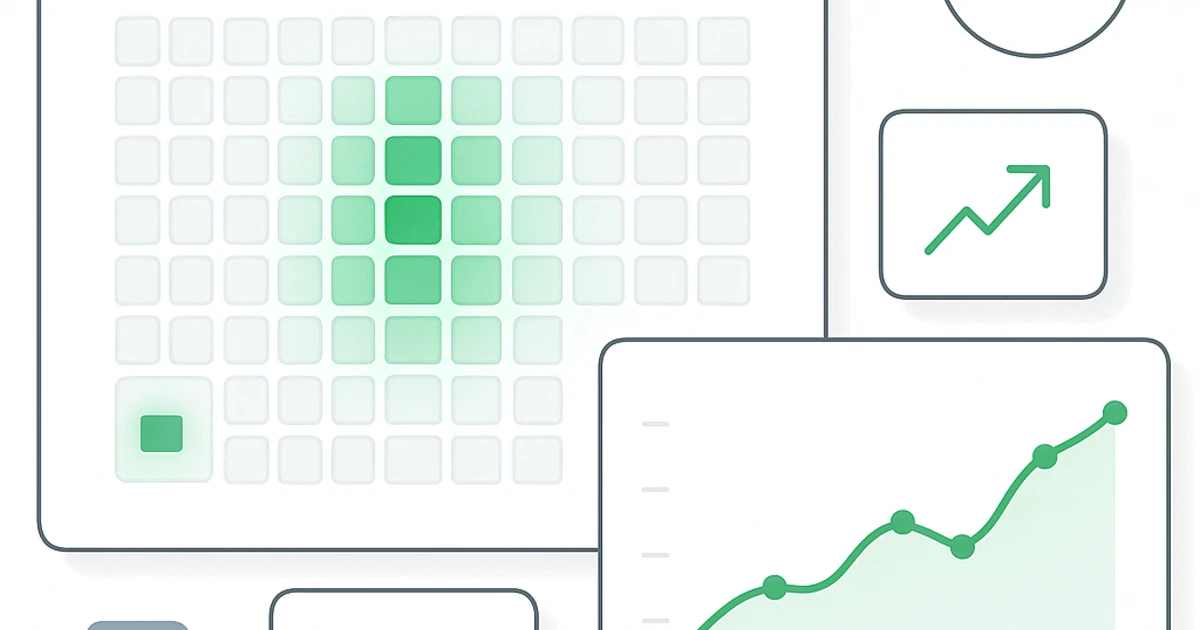
Best Time to Post on LinkedIn in 2026: Data-Driven Guide
Data-driven analysis of optimal LinkedIn posting times by day and hour. Engagement patterns, B2B vs B2C differences, timezone strategies, and auto-scheduling with Publora analytics API.
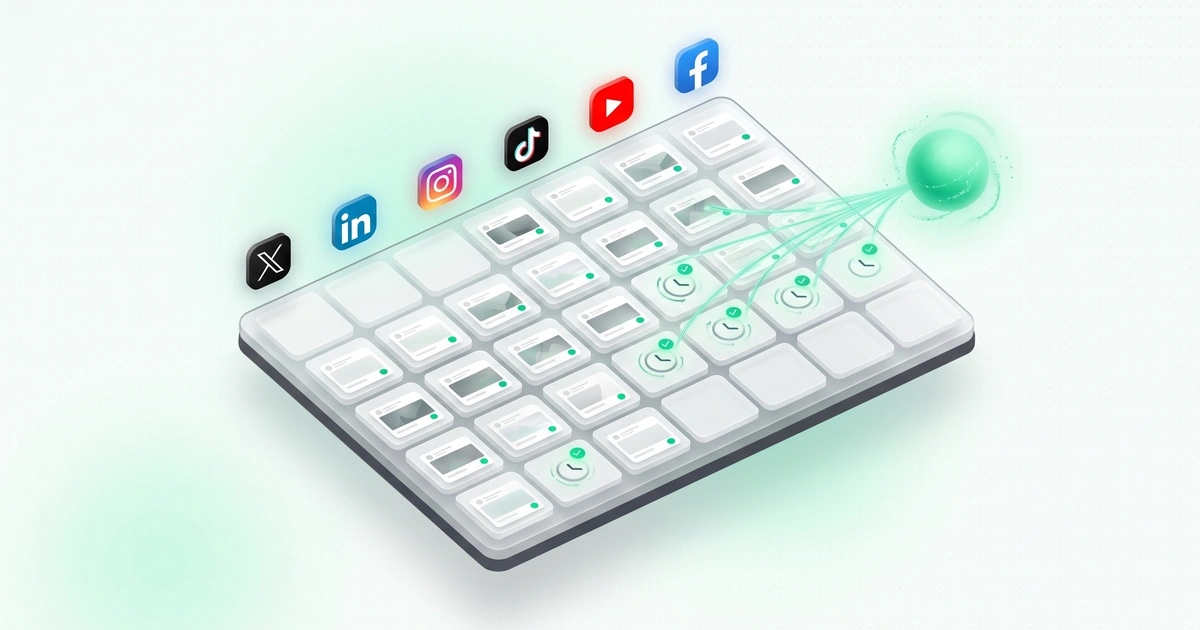
How to Build an AI-Powered Social Media Calendar
Build an AI-driven content calendar with content pillars, optimal posting frequency, and automated scheduling via Publora API. Includes Python script for generating weekly calendars.