Top 20 Social Media Platforms in 2026 (User Counts + What They're Best For)
TL;DR
The list of social platforms gets longer every year, but the right number to actually post on is small. This article walks through the 20 platforms that matter in 2026 — ranked by monthly active users
Top 20 Social Media Platforms in 2026 (User Counts + What They're Best For)
The list of social platforms gets longer every year, but the right number to actually post on is small. This article walks through the 20 platforms that matter in 2026 — ranked by monthly active users, with what each is genuinely useful for, who should post there, and which ten can be scheduled from a single tool.
Most creators waste effort spreading thin across platforms that don't fit their audience. The goal of this guide isn't to push you to all 20. It's to help you pick the 3 to 5 that earn their keep and ignore the rest.
TL;DR — In Five Bullets
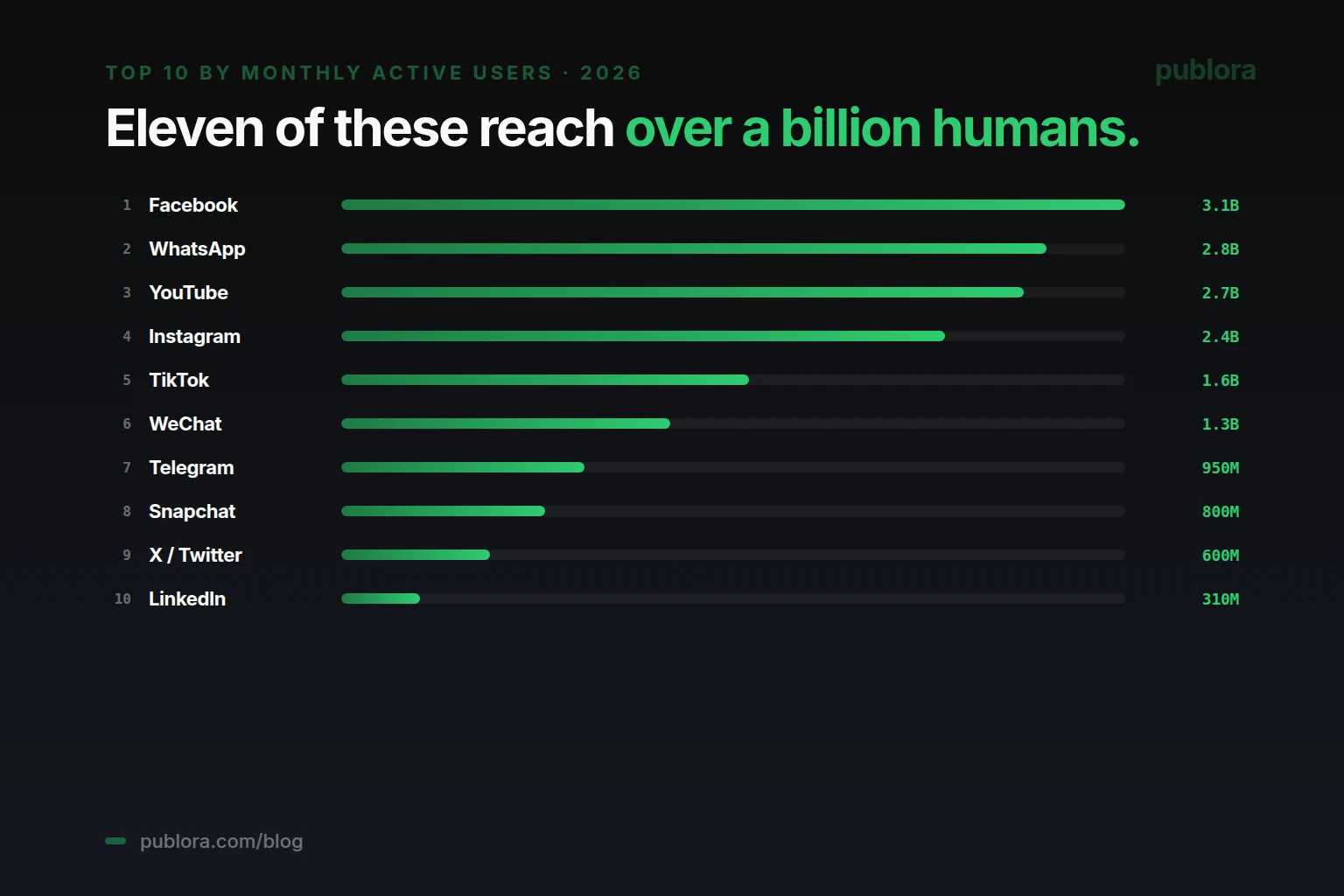
- Top 5 by MAU: Facebook 3.1B, WhatsApp 2.8B, YouTube 2.7B, Instagram 2.4B, TikTok 1.6B.
- Eleven platforms have over 1B users. Three more cleared 500M. The rest are sub-billion but still meaningful for niches.
- Pick 3 to 5 platforms, not all 20. 80% of results come from the top 1-2 for almost every creator.
- B2B leans LinkedIn + X + Medium + YouTube. B2C leans Instagram + TikTok + Facebook + Pinterest + YouTube. YouTube serves both.
- 10 of these 20 schedule from one place. The other 10 either lack APIs or are messaging-first.
How We Ranked These
The ranking is monthly active users (MAU), as reported by each platform's most recent public disclosures or industry analyses for late 2025 and early 2026. MAU is the most-cited metric for cross-platform comparison and is reasonable as a proxy for distribution potential — though, as we'll discuss, raw MAU isn't the same as audience fit.
The "best for" framing is based on which audiences each platform actually rewards content from in 2026: B2B versus B2C, broad reach versus niche depth, video versus text versus visual.
The Top 20, From Largest to Smallest
1. Facebook — 3.1B MAU
Still the largest. Demographics skew older in North America and Europe, younger in much of South Asia and Africa. Best for B2C with mature audiences, local businesses, and ad spend (Facebook Ads remain one of the most sophisticated targeting platforms anywhere). Organic reach for pages is low, but the platform's reach for paid distribution is unmatched.
2. WhatsApp — 2.8B MAU
A messaging app, not a feed-based social platform — but it's where customers actually talk to brands in many markets, especially Latin America, India, and Southeast Asia. Use cases: customer service, broadcast lists, business catalogs (via WhatsApp Business). Limited as a marketing channel because there's no public feed; growth comes through direct contact rather than discovery.
3. YouTube — 2.7B MAU
Video, with over a billion hours watched daily. Best for evergreen long-form content (tutorials, deep dives, product explainers) that compounds over years. Shorts have made YouTube competitive with TikTok for short-form discovery. Strong for both B2B and B2C — ranks like a search engine, which makes it the most discoverable platform on this list.
4. Instagram — 2.4B MAU
Visual storytelling. Demographics center on millennials and Gen Z. Reels are now the primary growth engine; static feed posts have declined in reach. E-commerce integration via Shopping is mature. Best for B2C, lifestyle brands, and personal brands with visual aesthetic.
5. TikTok — 1.6B MAU
Short-form video, viral by design. Demographics skew young but expand each year. Discovery is unusually generous — even a brand-new account can hit 100K views on a single post if the content fits. Best for: trend-driven brands, anything that benefits from sound and rapid iteration. Less useful for slow-cycle B2B.
6. WeChat — 1.3B MAU
Dominant in China. Integrated social, payment, e-commerce, and identity ecosystem — closer to a super-app than a social network. If you sell into China, you need a presence; if you don't, you can skip it. No path to scheduled posting from outside China for most foreign brands.
7. Telegram — 950M MAU
Privacy-focused messaging with broadcast Channels. Especially strong in Eastern Europe, Russia, the Middle East, and parts of Asia. Use cases for creators: channel broadcasts (one-way, like a newsletter), groups (community), bots. Channels have no algorithmic ranking — pure chronological distribution to subscribers.
8. Snapchat — 800M MAU
Gen Z. Ephemeral messaging, AR filters, Spotlight (TikTok-like discovery feed). Strong for brands targeting under-25 with playful, casual content. Limited for B2B. Snapchat's reach has stabilized rather than grown, but the audience that's there is highly engaged.
9. X (Twitter) — 600M MAU
Real-time discussion, news, B2B/tech/creator audiences. The platform has lost users since 2022 but the remaining audience is concentrated in tech, finance, journalism, and policy — high-value segments for B2B. The algorithm is open source, which makes it the most predictable major platform to optimize for. January 2026 added a Grok-powered ranking layer.
10. Reddit — 500M MAU
Community-driven, divided into subreddits by topic. The platform rewards genuine participation, not broadcast-style marketing. Best for: brands that have something genuinely useful to share and can engage in subreddit-specific norms. Misuse is heavily punished by community moderation. Strong for SEO — Reddit threads now appear prominently in Google search results.
11. Pinterest — 500M MAU
Visual discovery, primarily for purchase intent. Demographics skew female, with strong commercial intent — Pinterest users frequently use the platform to plan purchases (home, fashion, food, weddings). Best for: e-commerce, lifestyle, design, recipes. Less useful for service businesses or B2B.
12. Quora — 400M MAU
Q&A format. Best for: thought leadership and authority-building in specific knowledge domains. Slower-cycle than feed platforms — answers compound over years and rank in Google search. Quality of audience varies wildly by topic. Some niches (finance, software, medicine) have high-signal expert participation; others have devolved into spam.
13. LinkedIn — 310M MAU
Professional networking, B2B's default platform. Smaller MAU than the consumer giants, but the highest-value audience for B2B sales, hiring, and thought leadership. The 360Brew algorithm rewards saves and deep comments; personal profiles get 561% more reach than company pages on identical content. Best for founders, consultants, B2B marketers, and recruiters.
14. Threads — 275M MAU
Meta's text-based platform, launched in 2023, integrated with Instagram. Has grown faster than expected by leveraging Instagram's social graph. Audience leans toward Instagram-native creators and brands rather than the X migration crowd. Algorithm is still tuning — chronological-leaning feeds with discovery boosts. Worth a presence if you're already on Instagram.
15. Twitch — 240M MAU
Live streaming, originally gaming but now broader (just-chatting, music, IRL). Best for: real-time engagement, building parasocial relationships, streamer-style brands. Live-only nature means it's a high time-investment platform — most brands can't sustain it. The audience that's there is unusually loyal and high-engagement.
16. Discord — 200M MAU
Community servers — closer to Slack than to social media. Best for: creator communities, gaming brands, software products with active user communities, course creators. Discord doesn't reward broadcast posting; it rewards moderation, events, and consistent presence.
17. Tumblr — 135M MAU
Microblogging with strong creative/niche communities — fandoms, indie art, queer culture, fan fiction. Audience leans Gen Z. Best for: brands and creators with culturally adjacent content, indie aesthetic, or fandom roots. Niche platform but unusually high engagement when content fits.
18. Medium — 100M MAU
Long-form text. Best for: thought leadership, in-depth posts, founder essays. Medium's distribution depends on the topic publication you submit to (Better Programming, Marker, OneZero, etc.) more than on raw publishing. Strong SEO and Google Discover signals when articles perform. Less useful for visual or short-form content.
19. Bluesky — 25M MAU
Decentralized text-based platform on the AT Protocol. Has grown rapidly through 2024-2026 by absorbing parts of the X migration. Audience leans toward journalists, tech-policy people, and decentralized-web enthusiasts. Algorithm is still simple (chronological with light discovery), which makes it easier to grow on than the major platforms — early-mover advantage if you're in those audience segments.
20. Mastodon — ~1M MAU
Decentralized federation (the Fediverse), running on the ActivityPub protocol. Smallest by MAU, but very high engagement and signal in privacy-focused, open-source, and academic communities. Best for: brands and creators in those niches who want to hedge against single-platform risk.
Which Platforms for Which Audience
The MAU ranking tells you reach. The audience map tells you fit. Here's the four-bucket version that helps most creators choose where to actually invest.
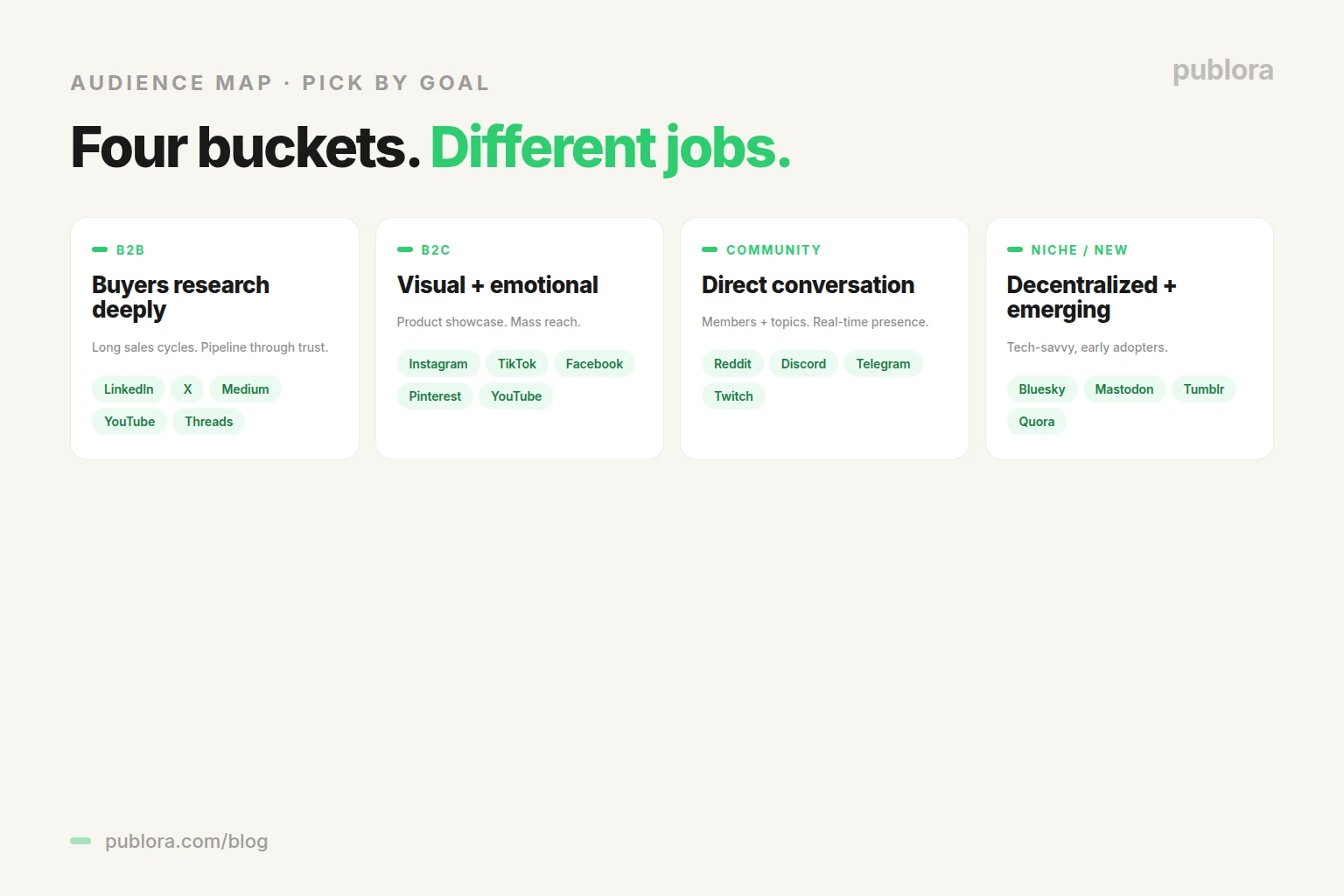
B2B: LinkedIn + X + Medium + YouTube + Threads
B2B buyers research deeply before purchasing. They reward thinking that helps them frame their own problem — frameworks, post-mortems, comparisons, opinions defended with evidence. LinkedIn is the default; X is the highest-velocity discussion platform; Medium and YouTube are the long-form options for compounding SEO; Threads is a low-cost adjacent channel if you're already on Instagram or LinkedIn.
B2C: Instagram + TikTok + Facebook + Pinterest + YouTube
B2C purchase decisions are emotional and visual. Instagram and TikTok dominate for reach and creative; Facebook still works for older demographics and as an ad platform; Pinterest captures purchase-intent audiences in lifestyle and home/design; YouTube serves both as discovery and as the long-form education layer for considered purchases.
Community: Reddit + Discord + Telegram + Twitch
Communities reward presence over broadcast. Reddit is the largest and SEO-rewarded; Discord is server-based and high-signal for software/creator communities; Telegram channels work like newsletters; Twitch is real-time and high-loyalty. None of these reward "post once and run" — they're investment platforms.
Niche / Decentralized: Bluesky + Mastodon + Tumblr + Quora
Smaller audiences, but each rewards a specific kind of fit. Bluesky for tech-policy and journalism; Mastodon for FOSS/privacy/academic; Tumblr for creative and fandom; Quora for SEO-driven thought leadership in knowledge-heavy domains. Cheap to maintain a presence on if you're already creating content for the major platforms.
Schedulable Platforms: Ten of the Twenty from One Place
The biggest practical question for a creator running on multiple platforms: which can you actually schedule from one tool? Here's what Publora supports and what it doesn't.
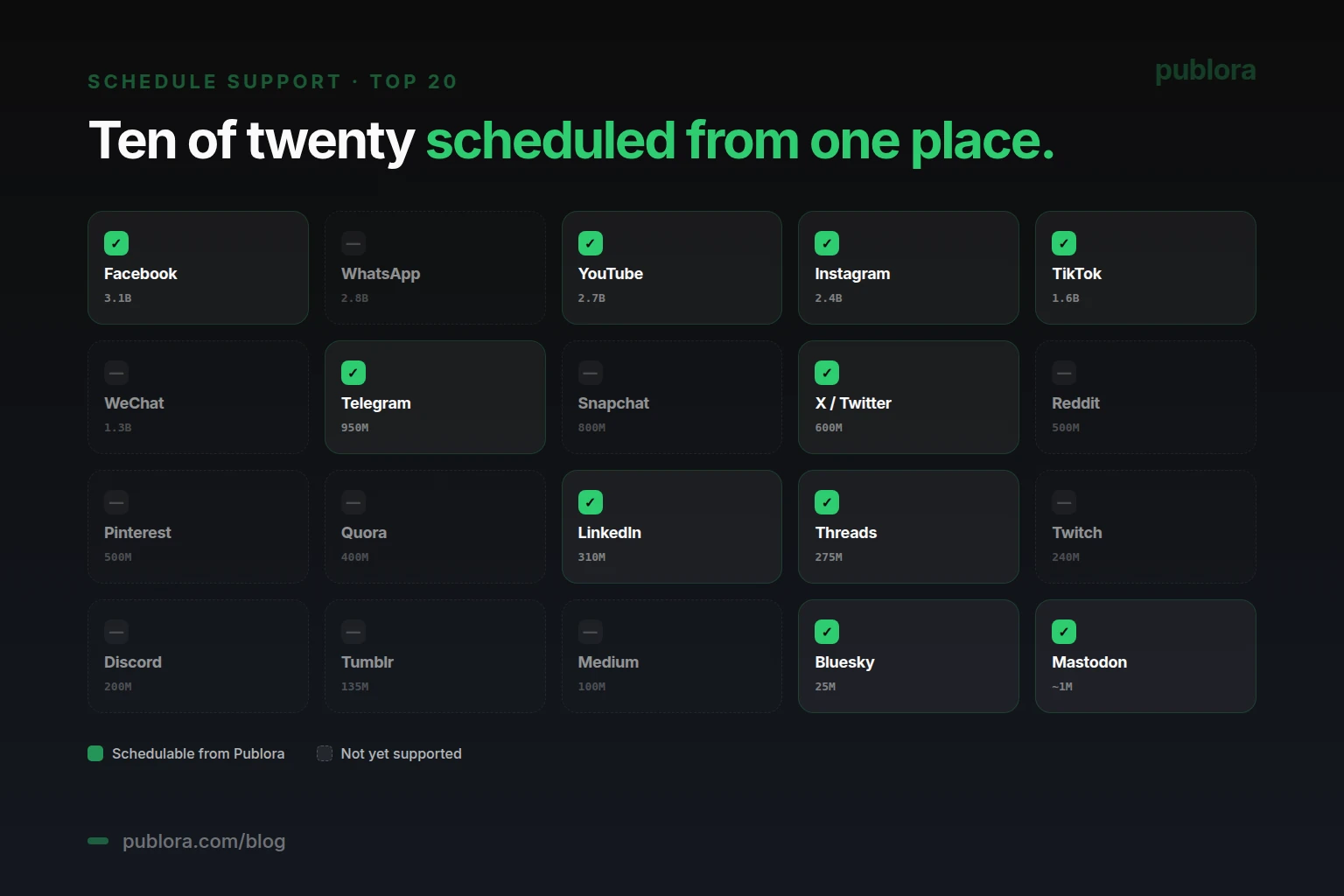
Schedulable from Publora (10): Facebook, YouTube, Instagram, TikTok, Telegram, X (Twitter), LinkedIn, Threads, Bluesky, Mastodon. These are the platforms with stable public publishing APIs and standard content formats — text, image, video, scheduled.
Not yet supported (10): WhatsApp, WeChat, Snapchat, Reddit, Pinterest, Quora, Twitch, Discord, Tumblr, Medium. The reasons vary:
- Messaging-first or no public feed: WhatsApp, Discord, Telegram (groups), WeChat. These don't have a "post to public feed" model in the way feed platforms do.
- No public publishing API: Snapchat, WeChat, Reddit (DMs/posts have strict community-norms rules that prevent generic scheduling).
- Content-platform niche: Pinterest, Quora, Twitch, Tumblr, Medium — supported by some single-platform tools but not all-in-one schedulers.
The roadmap for 2026 is to add Pinterest and Reddit (subreddit-aware) as the next major supported networks. The rest depend on platform API access — WhatsApp Business and Snapchat in particular require platform-side cooperation.
If you're running a multi-platform content strategy that includes platforms outside the schedulable 10, the practical workflow is: schedule the 10 supported platforms from Publora, post manually on the 1-2 niche platforms that matter to you. For most creators, that means scheduling 80-90% of content automatically and manually posting only to the niche channels. Reading the content calendar guide covers how to structure this workflow.
How to Choose 3-5 Platforms Without Spreading Thin
Most creators waste effort. The fix is mechanical:
- Anchor on one primary platform. The one your audience is on most. For B2B founders, this is almost always LinkedIn. For B2C creators, Instagram or TikTok.
- Add one secondary platform that complements the primary. X for B2B (real-time discussion to LinkedIn's longer-form), or YouTube/TikTok cross-platform for visual creators.
- Add one community platform. Reddit if your topic has an active subreddit; Discord if you're building a server; Telegram for Eastern European audiences.
- Optionally, one decentralized hedge. Bluesky or Mastodon if you have audience there. Cheap to maintain if you're cross-posting via Publora.
- Skip the rest. WeChat unless you sell into China. Pinterest unless you're in lifestyle/e-commerce. Quora unless you're playing the SEO long game in a knowledge-heavy niche.
Three to five platforms beats fifteen for almost every creator. The right three platforms posted to consistently for a year outperform fifteen platforms posted to inconsistently for a year — every time.
Frequently Asked Questions
What is the largest social media platform in 2026?
Facebook, ~3.1B MAU. WhatsApp 2.8B, YouTube 2.7B, Instagram 2.4B, TikTok 1.6B follow. The top five together reach 12.6B accounts (with significant cross-platform overlap).
Which platform grew fastest in 2026?
Threads (275M MAU, leveraging Instagram's social graph) and Bluesky (25M, capturing X migration share) showed the strongest growth among text-based platforms. TikTok continues adding users in non-US markets.
What's the difference between B2B and B2C platforms?
B2B platforms reward deep, slow-cycle content (LinkedIn, Medium, X, Threads, YouTube). B2C platforms reward visual, fast-cycle, emotional content (Instagram, TikTok, Facebook, Pinterest, YouTube). YouTube serves both. Community platforms (Reddit, Discord) work for both but reward presence over broadcast.
Should I post on every platform?
No. Pick 3 to 5 that match your audience. 80% of results come from the top 1-2 platforms for almost every creator. The right approach: pick the primary platform your audience is on, add one secondary, optionally a community platform, and skip the rest.
Which platforms can I schedule with Publora?
10 of the top 20: Facebook, YouTube, Instagram, TikTok, Telegram, X (Twitter), LinkedIn, Threads, Bluesky, Mastodon. The 10 not yet supported are messaging-first, lack public publishing APIs, or are content-platform niche — Pinterest and Reddit are on the 2026 roadmap.
Is X (Twitter) still relevant for B2B in 2026?
Yes — particularly for tech, founders, AI, finance, and policy/journalism. The audience is smaller than 2022 but more concentrated. The X algorithm being open source also makes it the most predictable major platform to optimize for.
What about Bluesky and Mastodon?
Worth a presence for tech-leaning audiences or as platform hedges. Bluesky 25M MAU (journalist/tech-policy), Mastodon ~1M MAU (FOSS/privacy/academic). Cheap to maintain if you cross-post via a scheduler.
Schedule 10 Platforms From One Place
Pick the 3-5 platforms that fit your audience, then schedule them all from one workflow. Publora covers ten of the top twenty — Facebook, YouTube, Instagram, TikTok, Telegram, X, LinkedIn, Threads, Bluesky, Mastodon — with platform-specific variants from a single composer. Try Publora free.
Serge Bulaev writes about social media platforms, scheduling tools, and how creator-side algorithms actually work. Founder of Publora and Co.Actor.
Sources
- DataReportal — Digital 2026 Global Overview
- Statista — Most popular social networks worldwide
- Bluesky Engineering Blog
- Mastodon — About
Related Reading
Related Articles
Instagram Algorithm 2026: How Reach Really Works Now
How the Instagram algorithm works in 2026 - the separate systems for Feed, Reels, Stories, and Explore, why sends beat likes, and what Instagram says not to do.
LinkedIn Algorithm 2026: How It Ranks Posts (and Why AI Search Cites Them)
How the LinkedIn algorithm works in 2026 - the AI ranking model, the signals that matter, what gets suppressed, and why your posts now show up in AI search.
LinkedIn Collaborative Posts: A Shared Byline Is Now a Feature
LinkedIn Collaborative Posts let two or more people and Pages co-publish one post to both audiences. Here's what they are, who they're for, and how to use them.
Publer vs Publora: Which Is Actually Cheaper Per Account? (2026)
Publer vs Publora on real 2026 pricing - per-account cost, post limits, platforms, and API/MCP. An honest look at which scheduler is actually cheaper.